
Storm & emergency · Hot Springs, AR
Emergency tree service in Hot Springs, Arkansas
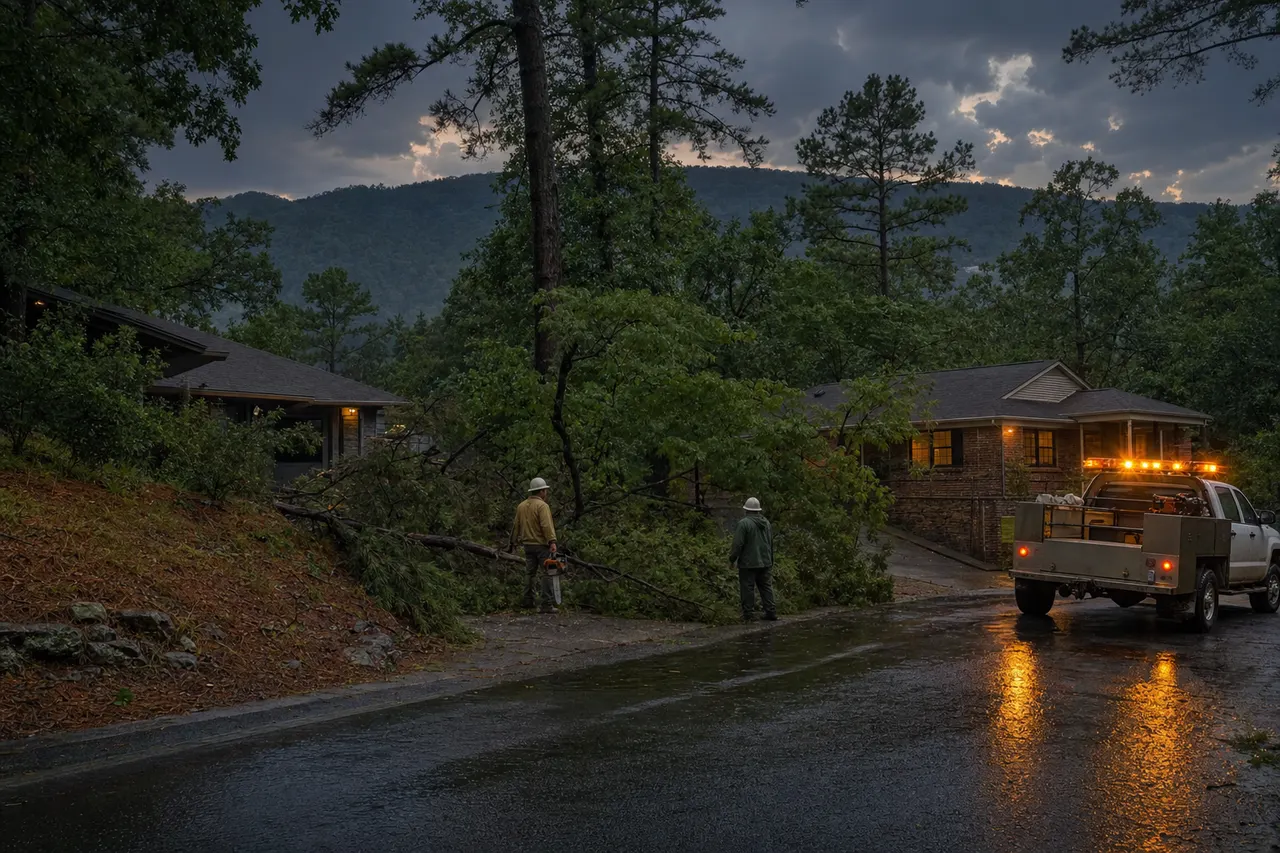
Trees on roofs, ice-snapped pines hanging over the house, limbs across the one drive off a hillside lot. Storm calls are answered first, day or night, and the price is written down before the saw starts.
Triage
What counts as a tree emergency, and what can wait
Around Hot Springs the difference is mostly about what the tree is touching and where the lot sits. A pine on the shingles is an emergency. So is a limb across a drive that switchbacks up from Highway 7 with no other way to the road, or a broken top still hung in the crown over the porch, or a trunk split down the middle with one half leaning at the neighbor's roof. Those go to the front of the line.
A tree lying on open grass is not one. It is a normal removal at the normal price, and it can wait a few days while the roofs get cleared. Saying so on the phone is part of the job.
Goes first
- Tree or limb on a house, garage, car, or dock
- Only drive off a hillside lot blocked
- Hanger caught in the crown over a roof or walkway
- Split or leaning pine over a structure, yours or the neighbor's
Waits for a normal estimate
- Tree flat on the lawn, nothing under it
- Limbs down in the woods at the back of the lot
- A stump left behind after the emergency cut
The first hour
What to do before anyone arrives with a saw
Look for the line
If any part of the tree is on a power line, a service drop, or the meter mast, it is Entergy's problem before it is anyone else's. Stay away from it, call the utility, and do not let a neighbor with a chainsaw near it. A line can be live with the house dark.
Photograph everything
Wide shots of the tree on the house, close shots of what it broke, the trunk where it failed. Take them before a single cut. Adjusters read pictures faster than descriptions, and the scene changes the moment the crew starts.
Tarp what you can reach safely
A hole in the roof under a limb that is not moving can be tarped from inside the attic or from the ground with a pole. Nobody should climb onto a roof with a tree on it. If the tree is shifting, leave the tarp for the crew.
Ice, wind, and the pines
Why storm damage in Garland County means pine damage
Ask anyone who was here for the ice storm at Christmas of 2000 and they will tell you what it sounded like: pines breaking all night. Ice loads a pine differently from an oak. The oak sheds limbs and keeps its trunk; the pine bends under the weight, and when it goes past a certain point the trunk cracks or the top snaps out. The state extension service's rule of thumb is that a pine bent past roughly 45 degrees usually has cracked bark and resin running, and it should be treated as a removal rather than a tree that will straighten. That guidance decides a lot of calls here every winter. There is more on it in the bent-pines guide.
Spring brings the other kind. Straight-line wind off a thunderstorm rolling over the ridges can put a whole row of loblollies down in one direction, and the occasional tornado track does not need explaining. Either way the failures are the same trees: tall pines standing over houses on slopes, with root plates in shallow rocky soil.
How storm work is sequenced
- Structures. Anything on a roof, a wall, or a car comes off first, rigged so the pieces lift away from the damage instead of dragging across it.
- Drives and access. Blocked drives, especially the single-track ones on the lake side, get cut open next so people can get out and adjusters can get in. For owners who are out of town when the storm comes, the guide to what a crew can handle at a lake house before you get there covers getting a crew in and agreeing the price by phone.
- Hangers and leaners. Broken tops still in the crown and trunks the wind loosened come down before the next front. The guide to why a hung limb comes down days after the storm also covers how a crew lowers one over a roof.
- Yards. Trees flat on the grass are last. They are not going anywhere, and they get the standard removal price when their turn comes.
Emergency pricing, honestly
What after-hours and storm work costs
Storm work carries a premium over the normal removal ranges, and it should. It is done in the rain, at night, on a roof, with the tree already broken and unpredictable. What it should never be is a number invented in your driveway after the work is done. The price is quoted before the saw starts, even at midnight, and it comes written and itemized the same as any other job: tree off the structure, debris hauled, stump if you want it.
Every storm brings trucks from out of the county knocking on doors with cash prices and no paper. A written number from a crew you can verify beats a fast handshake every time, and it is what your adjuster wants to see.
- Quoted before any cut, written and itemized, at any hour
- Premium stated as its own line, not buried in the total
- Insurance-ready: line items an adjuster can approve one by one
- No door-knock pricing, no cash-only surprises
Asked around Garland County
Storm and emergency questions, answered straight
What counts as an emergency tree removal?
A tree or a big limb resting on a house, a garage, a car, or a fence with a structure behind it. A tree across the only drive on a hillside lot. A hanger, meaning a broken limb still caught up in the crown over a roof or a walkway. A pine split down the trunk and leaning over the neighbor. Those jump the schedule. A tree lying flat on open grass hurting nothing is a normal removal at the normal price, and it can wait a few days.
Does homeowners insurance pay for storm tree removal?
Usually yes when the tree is on a structure: most policies pay to get the tree off the house and repair what it broke, minus your deductible. A tree down in the yard that hit nothing is usually out of pocket, though some policies carry a small debris allowance when a drive is blocked. Adjusters approve itemized line items faster than a lump sum, so the estimate you get here is written that way, and photographs taken before the first cut are the best paperwork you will ever own.
How fast can someone get here after a storm?
Storm calls are answered first, day or night. After a county-wide event the sequence is structures first, then blocked drives, then trees down in yards, so a tree on a roof is usually the same day and a tree on the lawn may be a few days out while the roofs get cleared. You hear where you sit in that order when you call, not after.
A tree came down on the power line to my house. Who do I call?
Entergy first, before anyone with a saw. A tree resting on a service drop or a distribution line can be energized even when the lights are out, and no private crew should touch it until the utility has dropped or cleared the line. Once the line is safe, the rest of the tree is an ordinary emergency removal and gets treated like one.
Written estimates, before any saw starts
Tree on the house? Say what it hit and where you are.
What the tree is touching, whether a line is involved, and which side of town. For a tree on a structure, call rather than type. For a tree on the lawn, the form is fine and the callback comes with a written number. Call (501) 781-0394.
- Itemized on paper - the tree, the haul-off, the stump if you want it gone
- A tree on a roof, a car, or a service drop jumps the schedule
- Steep-lot rigging and crane days are priced up front, never sprung after
Structures first, and a written number even at midnight
Storm calls go to the front of the line. The price is quoted before the saw starts, itemized the way your adjuster wants it.