
Tree trimming · Hot Springs, AR
Tree trimming in Hot Springs, Arkansas
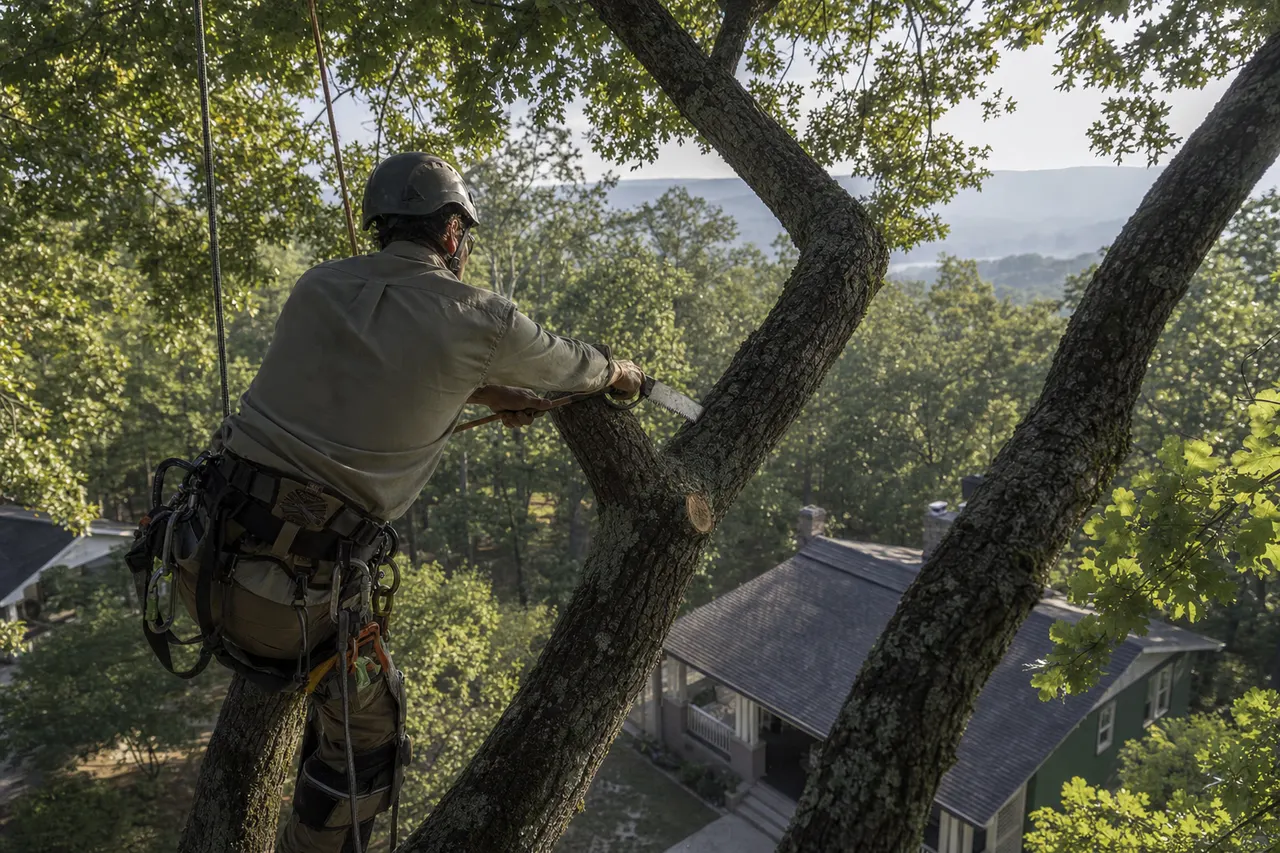
Deadwood out, weight off the house side, roof and line clearance, and a lake view opened the right way. Pruning cuts the tree can close over, from a climber on a rope, with the price in writing first.
What trimming is for
The trimming calls that come out of Hot Springs
The old streets off Park Avenue and Whittington grew up under white oak, post oak, and hickory, and those trees are now big enough to hold whole limbs over the porch roofs of the 1920s and 1940s bungalows beneath them. South of town it is pines over brick ranches, tall and thin, with the lowest live branches sixty feet up. The calls are about the same handful of things: a limb rubbing the shingles, a dead branch over the driveway, a pine leaning into the Entergy service drop, a crown that has gotten so heavy on the house side that every storm is a coin flip. Once the leaves drop, the winter call is often a set of green clumps high in a bare tree, and mistletoe in a bare hardwood comes out with the limb it grows in.
Trimming and pruning are the same work here. It means taking out what is dead, thinning what is crowded, raising the canopy off the roof and the drive, and reducing weight where a tree carries too much over something that matters. Each cut lands at the branch collar so the tree can seal it. What it never means is topping.
What a trimming job includes
- The walk. Which limbs, why, and how the climber gets to them. Rope access on hillside lots, a bucket where the drive allows one. Written, itemized estimate.
- Deadwood and hazards. Dead, cracked, and rubbing limbs come out first, regardless of season.
- Clearance and weight. Roof, gutters, drive, and the service drop get their room. Heavy limbs over the house side are reduced back to a strong lateral, never stubbed.
- Clean-up. Brush chipped, the lawn and the beds raked, the drive blown off. Under a burn ban the chips leave with the truck.
Why not topping
Topping a tree in ice country makes the next storm worse
Every few winters this part of Arkansas gets an ice event that loads the pines and oaks past what they can hold, and the 2000 ice storm is still the one people around here measure the others against. After a storm like that, a lot of homeowners have a tree topped, thinking a shorter tree is a safer tree. The Arkansas extension service keeps a before-and-after of exactly that: a tree topped after an ice storm, and the same tree five years on, carrying a dense broom of new shoots off every cut stub.
Those shoots are the problem. They grow fast, they attach to the outer wood of the old stub rather than the trunk, and they hold more weight on a weaker joint than the original limb ever did. The next ice or straight-line wind takes them out, often along with the stub. A topped tree also stops sealing its cuts, and rot works down into the trunk from every one.
The alternative is crown reduction: bringing the outer canopy back to well-placed lateral limbs, thinning the interior so wind moves through instead of against it, and raising the canopy where it sits on the roof. The tree ends up lighter on the house side and structurally better than it started.
Trimming ranges, Garland County
Per mature tree, clean-up included. Hedge and shrub rows are priced by the run or the hour. Cabling is its own line.
Lake lots
Opening a view without wrecking the trees
View clearing on Lake Hamilton and Lake Catherine is a trimming job, not a removal job, most of the time. Raising the canopy of the pines between the deck and the water, thinning the oaks so light and sight lines come through, and taking out the scrub layer underneath usually opens the view while keeping the trees that hold the slope together. Topping the pines to a height gets the view for two seasons and a row of broken-topped trees after that. Anything below the waterline side of a lake lot falls under Entergy's shoreline rules, and a good estimate says where that line is before a saw crosses it.
Crape myrtles
How to prune a crape myrtle, and how not to
Half the crape myrtles in Garland County have been cut back to knuckled stubs at fence height every February, a practice the trade calls crape murder for a reason. The tree survives it and blooms, which is why it keeps happening, but the stubs sprout weak whips that flop under the weight of their own flowers, and the trunks never develop the smooth mottled bark the tree is grown for. Correct pruning is light and late in winter: suckers off the base, crossing and inward limbs out, seed heads and twiggy tips tidied, the main trunks left alone to become a tree.
Cabling and bracing
Holding a good tree together
A big white oak that forked into two equal stems fifty years ago has a weak seam between them, and ice finds it. A tall pine that leans but is sound at the root can be worth keeping. Cabling ties the two stems together high in the canopy with a steel or synthetic cable so they move as one; bracing rods reinforce the fork itself. It is the alternative to removing a tree that is otherwise healthy, and it belongs in the hands of someone with the ISA credential. Whether a given tree is a cabling candidate or a removal is exactly the kind of judgment the walk settles.
Asked around Garland County
Trimming questions, answered straight
How much does tree trimming cost in Hot Springs?
Most trimming jobs on a single mature tree in Garland County run $300 to $850. A small ornamental or a crape myrtle sits at the bottom of that range, a tall pine or a big oak over a roof at the top, and a tree the climber has to rope into from a hillside lot with no bucket-truck access costs more than the same tree on flat ground. Hedge and shrub rows are priced by the run or the hour. The written estimate names your number before anything is scheduled.
Can you just top the tree so it stops hanging over the house?
Any crew this site connects you with will say no, and the reason is what topping does to a tree in ice country. A topped oak or pine answers by throwing out a thicket of fast, weakly attached shoots from the cut stubs. The Arkansas extension service has photographed exactly this after past ice storms: a tree topped in a panic, and the same tree five years later carrying more weight on worse attachments than it ever had. The honest fix for a tree over a roof is crown reduction and thinning, which takes the weight off the house side with cuts the tree can close over.
When is the best time to trim trees in Arkansas?
Late winter, while the tree is dormant and the branch structure is easy to read. Oaks in particular are best left alone through the warm months, roughly April into July, when the beetles that spread oak wilt are active and a fresh cut is an invitation. Crape myrtles are pruned in late winter too, lightly. Dead and hazardous limbs are the exception and come off whenever they are found.
My neighbor’s tree hangs over my yard. Can I have it trimmed?
Generally yes, up to the property line. The common rule Arkansas follows lets you trim overhanging limbs back to the line at your own cost, so long as the cutting does not kill or seriously harm the tree. A climber can make those cuts cleanly at the collar instead of hacking them off at the fence. If the tree itself looks dead or dangerous, that is a conversation with the neighbor first and a dated letter second. The guide on whose tree it is, under the tree owner guides on this site, walks through that.
Written estimates, before any saw starts
Tell us what the tree is doing over the house.
Which limbs worry you, how close they hang to the roof or the service drop, and whether the tree is an oak, a pine, or something else. A photo from the yard helps. Prefer the phone? Call (501) 781-0394.
- Itemized on paper - the tree, the haul-off, the stump if you want it gone
- A tree on a roof, a car, or a service drop jumps the schedule
- Steep-lot rigging and crane days are priced up front, never sprung after
A lighter tree, not a shorter one
Every trimming job starts with a walk around the tree and ends with an itemized estimate in writing. No topping, no stubs, no surprises.